









A Q&A with Toronto Tech Week co-founder Mell Truong on AI’s impact on the visitor journey and how the city’s tech ecosystem supports events tied to the sector.
World Tourism Day 2026 on September 27th, explores how artificial intelligence can help build a smarter, more inclusive and sustainable tourism sector under the theme “Digital Agenda and Artificial Intelligence to Redesign Tourism.”
Kelly Jackson, VP of Destination Development at Destination Toronto, spoke with Mell Truong, co-founder and Executive Director of Toronto Tech Week, returning May 31 to June 4, 2027, and Fractional Head of Partnerships at the Travel Trends Podcast. Together, they explored who benefits from AI’s transformation of tourism, the changing visitor journey, the impact on business events and the opportunities ahead for the visitor economy.

Kelly Jackson: With this year’s World Tourism Day theme focusing on AI and the digital agenda, how do you see generative AI changing the way travellers discover, research, and plan their trips to major urban destinations like Toronto?
Mell Truong: The biggest change is that travel discovery is becoming more conversational and hyperpersonalized. Instead of starting with a Google search for things to do in Barcelona or things to do in Toronto, a visitor can utilize AI and say, “I'm going to Toronto for 4 days. I love food, live music, and sports. I'm traveling with my girlfriends or my kids and I don't want to do the obvious tourist things.” Then the AI can build an itinerary around that specific person instead of a generic list that you would find with a simple search.
"Toronto Tech Week works because it isn't a tech conference that happens to be in Toronto. It comes out of the ecosystem that's already here.”
- Mell Truong, co-founder and Executive Director of Toronto Tech Week
At the Travel Trends Podcast, we talk with travel executives every week about their approach and the pattern that comes up consistently is that they're rethinking discovery as a conversation from the ground up. For destinations, especially Toronto, the opportunity and the risks are the same thing. Toronto, I believe, has an enormous amount of depth. Neighbourhoods, small businesses, and cultural moments can disappear if AI keeps resurfacing the same top 10 things to do because that's what is best indexed. For a city like ours, the city and operators that make their information current, structured, and genuinely rich are the ones that AI will recommend. The ones that don't risk becoming invisible in a way that a bad Google ranking has never made them. Visitors will, however, still need a human element of reassurance that real people have been there.
KJ: Through your work with the Travel Trends podcast, you track how technology shapes traveller behavior. How can destinations leverage AI to enhance the on-the-ground visitor experience—such as hyper-personalized recommendations or real-time navigation without losing authentic human connection?
MT: Through conversations on the podcast, we've seen that the best use of AI in a destination isn't more content, it's better timing. Most visitors aren't really short on recommendations. You can get recommendations from all sorts of sources. They're short on the relevant ones at the right moment.
If you're in Toronto and it starts raining or somebody suddenly has a block of hours that has freed up between meetings, the opportunity is for AI to read the moment. Where they are, what they're actually interested in, what's open and nearby right now, and be able to surface two or three genuinely good options instead of a list of a hundred. That's the real shift. It's less searching, more experiencing. And where I think destinations need to be careful is treating technology as the product. The goal is never a slicker app. It's getting somebody into a neighbourhood that they'd have otherwise walked past or into a restaurant that's a hidden gem.
It's not so much “how does AI help Toronto attract people?” The better question is: How can technology help Toronto connect the right visitor with more of what makes this city special, while spreading the benefits of visitation more broadly?

KJ: As a co-founder of Toronto Tech Week, how did Toronto's position as a major tech and AI hub shape the event, and why is it vital for business events to directly reflect a city’s specific economic and knowledge strengths?
"Some of the memorable events aren't the traditional panels or workshops. Last year you could go from a major AI discussion to a pasta making class with a group of founders.”
- Mell Truong, co-founder and Executive Director of Toronto Tech Week
MT: We just recently announced the return of Tech Week in 2027. Toronto Tech Week works because it isn't a tech conference that happens to be in Toronto. It comes out of the ecosystem that's already here. Toronto has incredible strengths across AI, fintech, healthcare, health tech, venture, research, emerging technology, and so many other parts of the innovation economy. We have founders, major global companies, universities, investors and such a diverse talent base all operating within the same city. Tech Week really gives that ecosystem a reason to open its doors and bring people together.
In 2026, more than 600 events happened across the city hosted by over 700 organizations, which means that you're not just walking into one venue and leaving without really experiencing Toronto. I think that's really important for business events. The strongest ones should really feel connected to the place that they're in. Ideally, someone leaves understanding not only what they learned, but also why Toronto was the right city for that conversation to happen in the first place.
As we look towards 2027, we want to continue to make sure that we're building for the entire ecosystem and not just the loudest parts of it because there's so many things that we can showcase and highlight.

KJ: Major tech gatherings draw thousands of founders, investors, and delegates into local neighbourhoods. How is Toronto Tech Week evolving from a more local event to one that draws Canadian and international visitors?
MT: The conversations from year one to year two were quite different. Year one was a lot of education on what Toronto Tech Week was and that it's not just Toronto businesses. We had conversations with so many attendees from across the globe asking, “We heard about Toronto Tech Week, what is it? How do we get involved?” That was really the exciting thing from year one to year two. Toronto Tech Week has become a reason for people outside the city to put Toronto on their calendar.
This past year 32,000 people attended across the week, from 87 different countries and over 500 cities. We're still very much rooted in the Toronto ecosystem, but there's a real opportunity to build on that international interest.
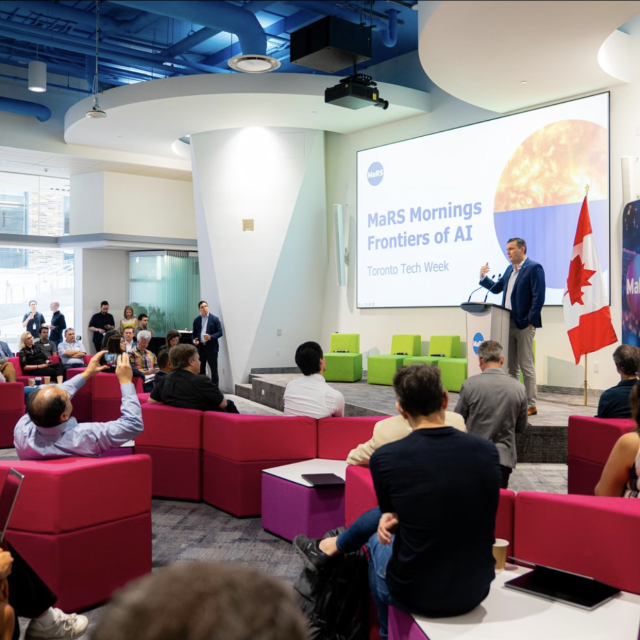
Part of what makes the week interesting to a visitor is that you get to experience Toronto while here. You're moving between neighbourhoods. Some of the memorable events aren't the traditional panels or workshops. Last year you could go from a major AI discussion to a pasta making class with a group of founders. You could find yourself in the East End and then downtown core and then Kensington Market and you're learning but you're experiencing at the same time. The beauty of tech week is the breadth of things you can do. We want to continue to expand on that international interest and get even more people here in person.
"AI can really help someone discover the city, but the reason they'll choose Toronto and come back is still the human elements, the people, the neighbourhoods, the culture, the food, and the experiences they discover once they're here.”
- Mell Truong, co-founder and Executive Director of Toronto Tech Week
KJ: Looking ahead, what is the single biggest opportunity or action item Toronto’s tourism operators should prioritize to stay competitive as AI continues to transform how people choose where to meet, work, and travel?
MT: I have lots of thoughts here, but I really do think the biggest opportunity is making Toronto easier to discover in a really specific way. We mentioned AI is moving us away from everyone getting the same list of the top 10 things to do and as they are able to customize ideas, increasingly people are going to ask for exactly the experience that they want. So, where should a group of fintech executives have dinner after a conference? What's happening within walking distance after dinner? Where should I take my kids after a business trip? Tourism operators really need to make sure that their information is current, detailed, and easy for these platforms to understand and recommend.
But I wouldn't lose sight of Toronto's real competitive advantage. And AI can really help someone discover the city, but the reason they'll choose Toronto and come back is still the human elements, the people, the neighbourhoods, the culture, the food, and the experiences they discover once they're here.
AI can make travel recommendations much easier and much more personal, but the product still has to be Toronto. Technology can help someone discover the city, but it can't replace what makes the city worth discovering.

KJ: World Tourism Day strongly emphasizes sustainable growth alongside technological innovation. How can AI and data-driven tools be harnessed to make urban tourism more environmentally sustainable?
MT: I think one of the biggest opportunities is using AI and real-time data to help cities better manage visitor flow. If certain areas are especially busy, technology can help surface other neighbourhoods, attractions or times to visit, which can help reduce pressure on the same high-traffic areas. AI can also make more sustainable choices easier for the traveller. Things like prioritizing walking, public transit or experiences that are close to where someone is already staying can make a trip more efficient without asking the visitor to do all of that planning themselves.
There’s also a really practical opportunity for hotels, restaurants, venues and attractions to use better forecasting to understand demand, which can help reduce food waste, excess inventory and unnecessary energy use.
I also think it’s important to acknowledge that AI itself has an environmental footprint, so it shouldn’t be about using technology for the sake of it. The value is really in whether we can use it to make smarter decisions around transportation, energy, waste and how people move through a city.
Ultimately, I think AI gives us an opportunity to move from simply measuring tourism’s environmental impact after the fact to making smarter decisions about how people experience a city in real time.